
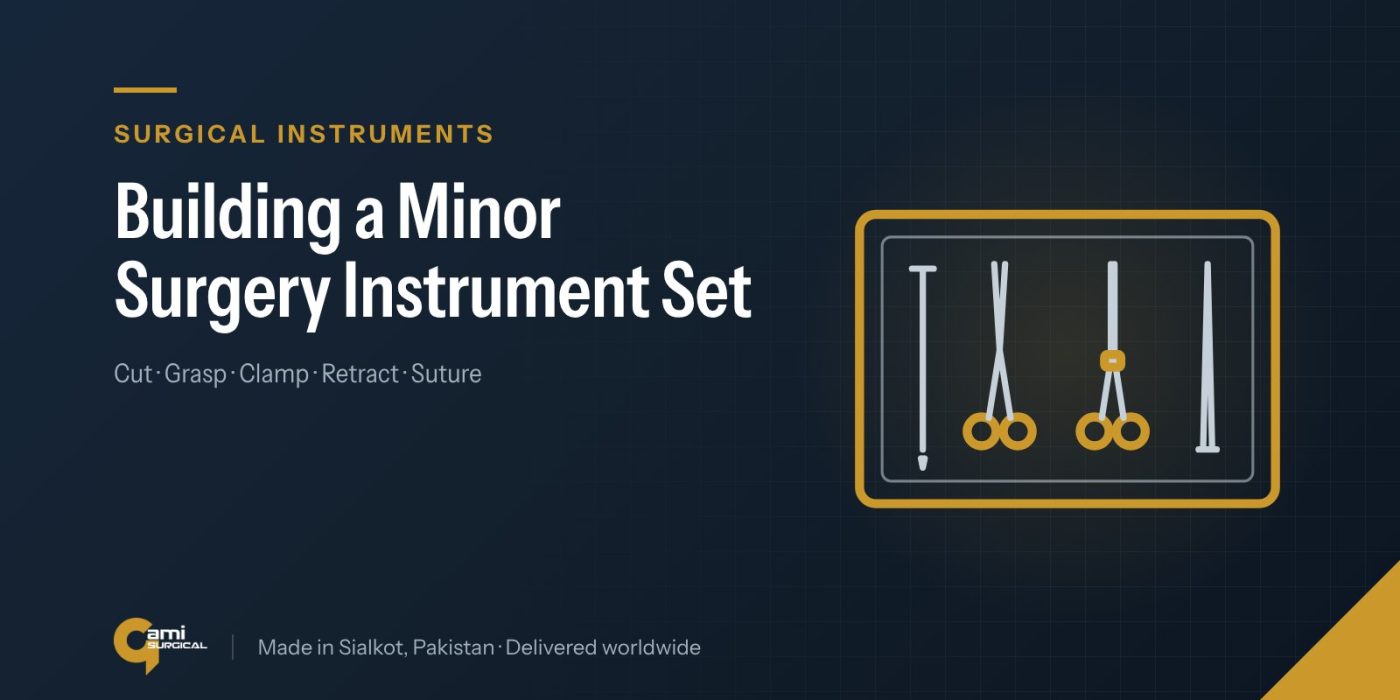
Clinics, GP surgeries, urgent care centres and outpatient departments carry out many small procedures: removing skin lesions, draining abscesses, repairing lacerations and taking biopsies. Having a well-planned set for this work saves time, keeps procedures consistent and makes reprocessing simpler. This guide sets out what goes into a minor surgery instrument set, so you can plan your own.
Note
Every set should be agreed with the clinicians who will use it, and with your sterile services team. Use this list as a starting point, not a standard.
Plan by function#
A useful way to plan any set is to work through what the user needs to do: cut, grasp, clamp, retract, suture, and handle swabs and dressings. Then choose the smallest number of instruments that covers each step.
1. Cutting#
- Scalpel handle No. 3, which takes the smaller blades such as No. 10, 11 and 15. The No. 15 blade is the usual choice for small, precise incisions.
- Iris scissors for fine cutting and trimming.
- Metzenbaum scissors (short) for delicate dissection.
- Straight Mayo or stitch scissors for cutting sutures.
2. Grasping#
- Adson tissue forceps with teeth for handling skin edges.
- Adson dressing forceps (without teeth) for gentler handling.
3. Clamping#
- Halsted mosquito forceps, curved and/or straight, usually several per set, for small vessels and for holding tissue or sutures.
4. Retracting#
- Skin hooks (single or double) to lift skin edges gently.
- A small hand-held retractor such as a Senn (double-ended, with rake and blade ends) for slightly deeper work.
5. Suturing#
- A short needle holder suited to the sutures used, often a Mayo-Hegar or Webster pattern, or an Olsen-Hegar if the user often works alone.
6. Swabs, drapes and dressings#
- Sponge-holding forceps for skin preparation.
- Towel clamps if reusable drapes are used.
- A gallipot or small bowl for antiseptic, and a kidney dish.
- A probe (for example a malleable probe) for exploring wounds and abscess cavities.
Example: a basic minor surgery instrument set#
| Instrument | Suggested quantity |
|---|---|
| Scalpel handle No. 3 | 1 |
| Iris scissors, curved | 1 |
| Metzenbaum scissors, short | 1 |
| Stitch or straight Mayo scissors | 1 |
| Adson forceps, with teeth | 1 |
| Adson forceps, without teeth | 1 |
| Halsted mosquito forceps | 2 to 4 |
| Needle holder | 1 |
| Skin hooks | 1 to 2 |
| Senn retractor | 1 to 2 |
| Sponge-holding forceps | 1 |
| Probe | 1 |
| Gallipot and kidney dish | 1 each |
Specialised variations#
- Laceration repair sets can be smaller: needle holder, toothed forceps, suture scissors and one or two mosquitoes.
- Incision and drainage sets add a curette and a probe, and sometimes a larger hemostat for breaking up loculations.
- Skin biopsy and excision sets often add fine skin hooks, a Webster needle holder and finer forceps.
- Suture removal sets need only a stitch scissors and fine forceps.
Practical tips for set design#
Set design checklist
- Use a standard tray list for each set, with photos, so it is packed the same way every time.
- Keep sets small: every extra instrument adds cleaning time and weight.
- Choose one length per pattern where possible, to make packing simpler.
- Order spares of the instruments most often damaged or lost, such as scissors and mosquitoes.
- Mark instruments clearly (for example with laser marking or colour bands) if you run several similar sets.
Order complete sets or single instruments#
Gami Surgical manufactures surgical instruments in Sialkot, Pakistan, and delivers worldwide. Send us your tray list, or the procedures you want to cover, and we will quote for the instruments individually or as complete sets.