
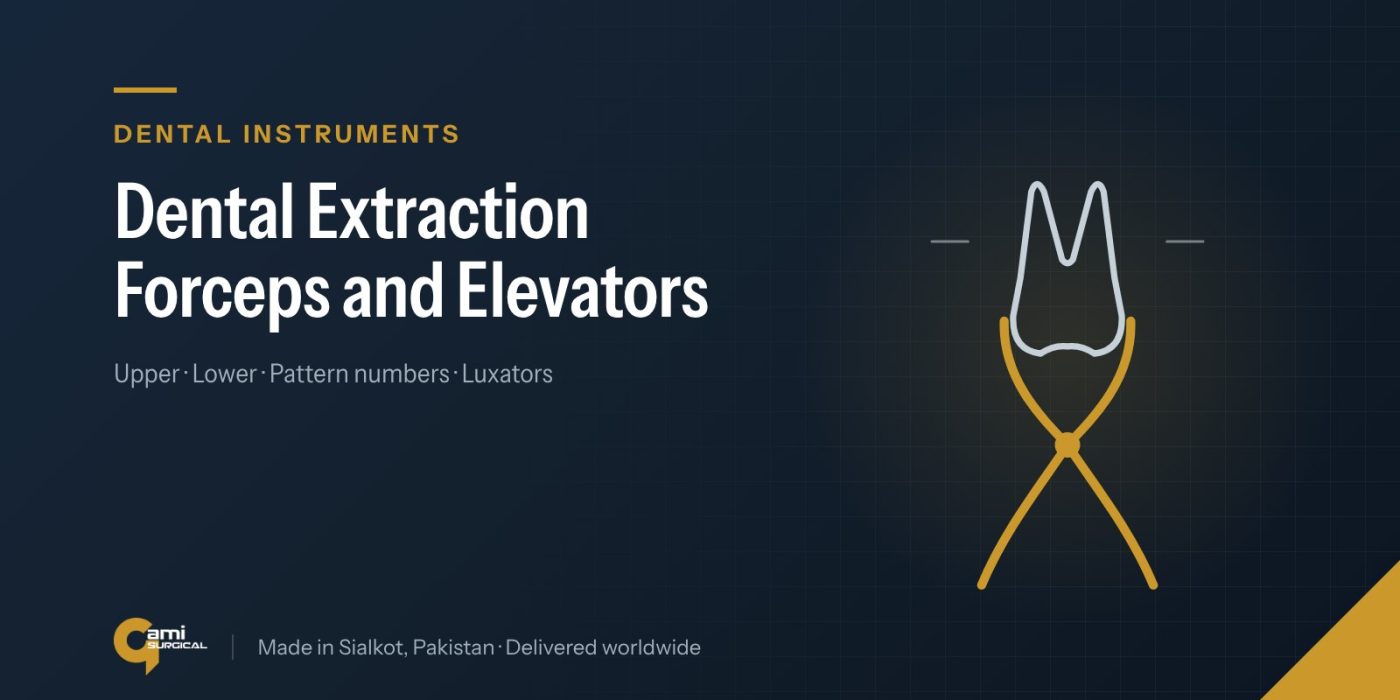
Dental extraction forceps and elevators are designed around the shape of the teeth they remove. A forceps that fits the crown and root closely gives the dentist control and reduces the risk of fracturing the tooth; one that fits poorly slips and crushes. This guide explains how extraction forceps and elevators are organised, so clinics and dental suppliers can order the right patterns.
In short
Forceps are designed for the upper or lower jaw and for particular teeth. Patterns are identified by numbers, which differ between American and English (European) styles, so always state the style and number when ordering. Elevators and luxators loosen the tooth before the forceps is used.
Upper or lower: how to tell at a glance#
- Maxillary (upper) forceps have beaks that are roughly in line with the handles, or angled in a “bayonet” shape for teeth further back in the mouth.
- Mandibular (lower) forceps have beaks set at roughly a right angle to the handles, so they can reach down onto lower teeth.
Beaks: matched to the tooth#
The beaks are shaped to fit the crown and root of particular teeth. Single-rooted teeth (incisors, canines and most premolars) are removed with forceps that have rounded, concave beaks. Molars have several roots, so molar forceps often have a pointed beak designed to sit in the furcation between the roots. Molar forceps for the upper jaw are made in left and right versions, because the buccal roots are on different sides.
Pattern numbers: American and English styles#
Forceps are identified by pattern numbers. Two numbering systems are in common use, so the same number does not mean the same instrument in both:
- American pattern forceps are widely used in North America and many other markets. Well-known examples include No. 150 (maxillary universal), No. 151 (mandibular universal), No. 53 L/R (upper molars), No. 210 (upper third molars) and No. 23 “cowhorn” (lower molars).
- English (European) pattern forceps are common in the UK, Europe and many other countries, and have their own numbering and handle shapes.
When you order, state the style and number, and if you can, send a photo or catalogue reference of the forceps you use now.
| Example (American pattern) | Used for |
|---|---|
| No. 150 | Maxillary universal: upper incisors, canines and premolars |
| No. 151 | Mandibular universal: lower incisors, canines and premolars |
| No. 53 L / No. 53 R | Upper first and second molars, left and right |
| No. 210 | Upper third molars |
| No. 17 | Lower first and second molars |
| No. 23 (cowhorn) | Lower molars, beaks engage the furcation |
Children’s (paediatric) forceps are smaller versions for primary teeth, and root forceps have narrow, fine beaks for retained roots.
Elevators, luxators and periotomes#
Most extractions begin by loosening the tooth in its socket before the forceps is applied. Three instrument types do this in different ways:
- Elevators have a sturdy blade used to apply controlled leverage and rotation. Common types include straight elevators, and paired left and right patterns such as Cryer elevators for roots.
- Luxators have a thin, sharp blade that is worked down the root to cut the periodontal ligament. They are meant for cutting, not for levering, and the tip can be damaged if they are used as an elevator.
- Periotomes have very fine blades for severing the ligament with minimal trauma, which is valued when the bone and soft tissue need to be preserved, for example before implants.
Root tip picks and fine apical elevators complete most extraction kits, for retrieving fractured root tips.
What to look for in dental extraction forceps and elevators#
Quality checklist
- The beaks close evenly and meet without gaps, and their inner surfaces are finely serrated for grip.
- The joint moves smoothly with no side-to-side play.
- Handles are comfortable and give a secure grip, without sharp edges.
- Elevator and luxator blades are straight, with tips that are sharp and undamaged.
- Pattern numbers are clearly marked on each instrument.
Care and reprocessing#
Clean forceps with the joint open, and brush the serrations on the beaks. Check elevators and luxators for bent or chipped tips after every use, and protect fine tips during cleaning and sterilization. Lubricate forceps joints with a water-soluble instrument lubricant before sterilizing.
Order dental instruments from Gami Surgical#
Gami Surgical manufactures dental extraction forceps, elevators and other dental instruments in Sialkot, Pakistan, and delivers worldwide. Send us your list with pattern style, numbers and quantities, and we will reply with specifications and a quote.
Source extracting forceps (english pattern) from Gami Surgical#
Gami Surgical makes extracting forceps (english pattern) in Sialkot, Pakistan, under ISO 13485 and ISO 9001 quality systems, with CE marking (EU MDR) and US FDA registration. Browse our extracting forceps (english pattern) or send an inquiry with the sizes and quantities you need. We reply with prices, lead time and shipping to your country, usually within one working day.