
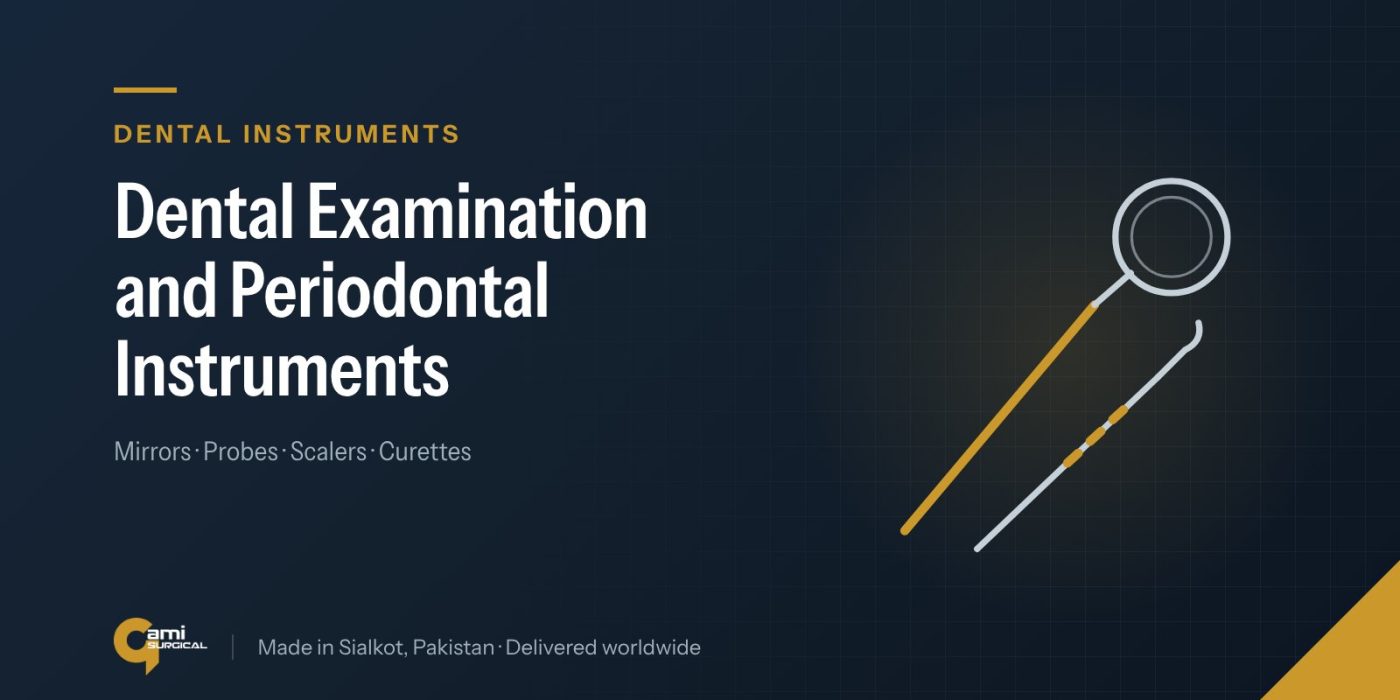
Every check-up and hygiene appointment relies on a small group of hand instruments. Because they are used so often, small differences in balance, sharpness and markings make a real difference to the clinician’s day. This guide covers the basic examination kit and the periodontal instruments used for scaling and root debridement.
In short
The basic examination kit is a mirror, an explorer, a periodontal probe and cotton pliers. For scaling, sickle scalers work above the gumline and curettes below it. Universal curettes have two cutting edges; Gracey curettes have one and are designed for specific areas of the mouth.
The examination kit#
Mouth mirrors#
Mirrors are used for indirect vision, retracting the cheek and tongue, and reflecting light. Front-surface mirrors give a sharp image with no double reflection; standard (rear-surface) mirrors are more durable. Mirror heads come in several sizes and screw onto separate handles, so heads can be replaced when scratched.
Explorers#
Explorers have fine, flexible, pointed tips for detecting calculus, defective margins and surface irregularities by feel. Common designs include the shepherd’s hook (No. 23), the No. 17 and the Orban-type explorer, often combined in double-ended instruments.
Periodontal probes#
Probes measure pocket depth and attachment levels. They differ in their markings:
- Williams probe: markings at 1, 2, 3, 5, 7, 8, 9 and 10 mm.
- UNC 15 probe: markings at every millimetre to 15 mm, with bands at 5, 10 and 15 mm.
- WHO (CPI) probe: a ball tip and a coloured band, used for periodontal screening.
Clear, durable markings are essential, so check that they are laser-etched or banded, not just printed.
Cotton pliers#
Angled pliers for placing and removing cotton rolls and small items in the mouth, available with serrated or smooth tips and with or without a locking mechanism.
Periodontal instruments#
Sickle scalers#
Sickle scalers have a pointed tip, a triangular cross-section and two cutting edges. They are used to remove supragingival calculus, especially between anterior and posterior teeth. Common patterns include the H6/H7 and the 204S.
Universal curettes#
Curettes have a rounded toe and back, which makes them safer below the gumline. Universal curettes (for example Columbia 13/14 or Barnhart patterns) have two cutting edges and a face set at 90 degrees to the lower shank, so one instrument can be adapted to most areas of the mouth.
Gracey curettes#
Gracey curettes are area-specific. Each has one cutting edge on an offset blade, set at about 70 degrees to the lower shank, and each number is designed for particular teeth and surfaces:
| Gracey | Designed for |
|---|---|
| 1/2, 3/4 | Anterior teeth |
| 5/6 | Anterior teeth and premolars |
| 7/8, 9/10 | Posterior teeth, facial and lingual surfaces |
| 11/12 | Posterior teeth, mesial surfaces |
| 13/14 | Posterior teeth, distal surfaces |
Variations with longer shanks or shorter, thinner blades are available for deep pockets and tight spaces.
Handles and ergonomics#
Clinicians hold these instruments for long periods, so handle design matters. Wider, lighter handles with textured grips reduce pinch force and hand fatigue. Hollow handles are lighter; solid handles can give a stronger tactile feel. Coloured rings on the handle help identify instruments quickly in cassettes.
Keeping scalers and curettes sharp#
A dull scaler or curette burnishes calculus instead of removing it, and makes the clinician press harder. Sharpness can be checked by drawing the edge lightly across a plastic test stick: a sharp edge bites, a dull one slides. Sharpen regularly with a suitable stone, keeping the original blade angles, and replace instruments when the blade becomes thin or weak.
Care checklist
- Clean instruments promptly after use; do not let debris dry on them.
- Use cassettes or racks to protect tips during cleaning and sterilization.
- Inspect tips under magnification for bends, chips and worn markings.
- Sharpen scalers and curettes regularly and test them before use.
- Replace probes when markings become hard to read.
Order dental instruments from Gami Surgical#
Gami Surgical manufactures dental examination and periodontal instruments in Sialkot, Pakistan, and delivers worldwide. Send us the patterns, handle styles and quantities you need, and we will reply with specifications and a quote.
