
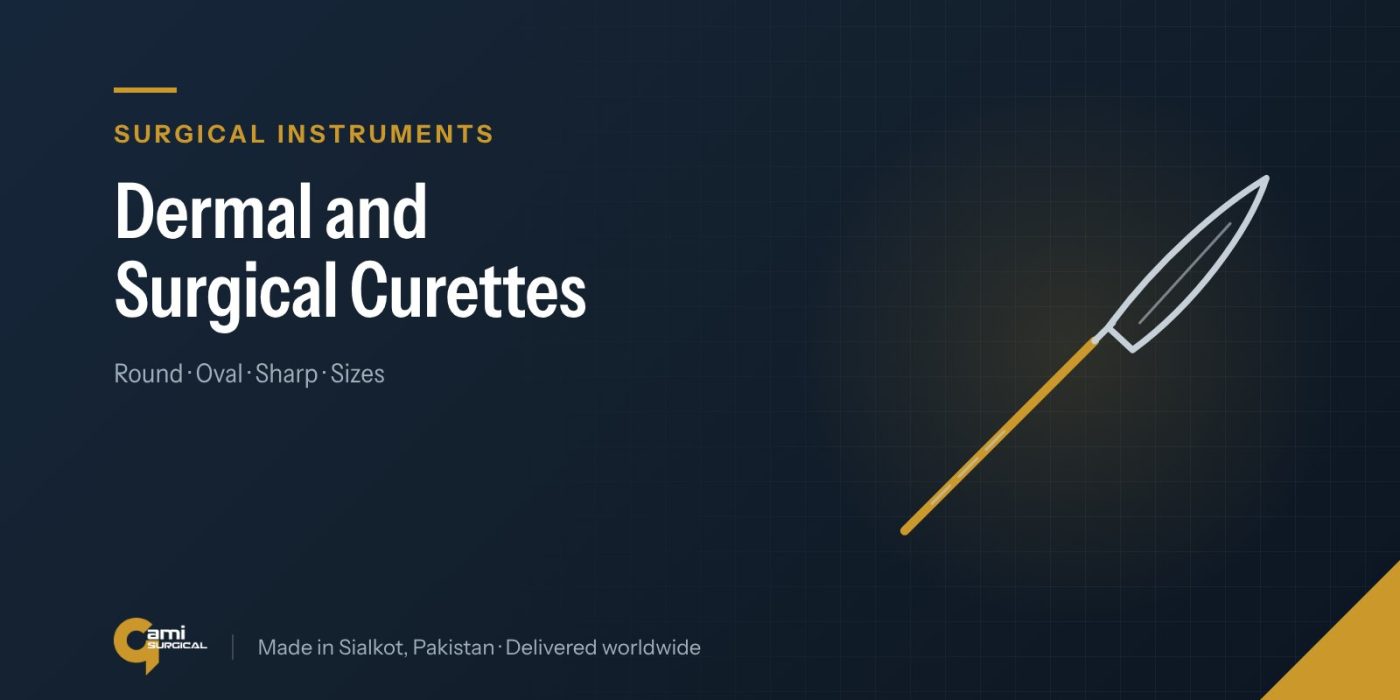
Dermal curettes are scraping instruments with a small, sharp-edged cup or loop at the tip. They are used in dermatology and minor surgery to remove soft skin lesions and to clean wounds and cavities. Unlike a scalpel, a curette removes soft tissue while largely sparing the firmer tissue beneath.
In short
Choose the cup size to match the lesion, keep the edge sharp, and use round or oval cups depending on the area. Reusable stainless steel curettes need regular inspection and sharpening.
How a curette works#
The cup has a sharp rim on one side. When the curette is drawn across the skin, the rim scoops out soft, abnormal tissue, which tends to separate more easily than healthy tissue. This difference is why curettage is used for certain superficial lesions, often combined with other treatment.
Shapes and sizes#
| Feature | Options |
|---|---|
| Cup shape | Round or oval |
| Cup size | Commonly from about 2 mm to 7 mm across |
| Handle | Flat, round or hexagonal; single- or double-ended |
The Fox dermal curette, with a flat handle and a round or oval loop, is one of the best-known patterns. Double-ended curettes give two sizes in one instrument.
Other surgical curettes#
Curettes are also used in many other specialties, with different designs: bone curettes in orthopaedics, ear curettes in ENT and uterine curettes in gynaecology. They are larger or shaped differently, so specify the specialty and pattern when ordering.
Keeping dermal curettes sharp#
Care checklist
- Inspect the rim under magnification for nicks and dull areas.
- Clean the cup carefully; tissue can collect inside it.
- Store curettes so the rims do not touch other instruments.
- Have them sharpened when they start to slide instead of scoop.
Frequently asked questions#
What size dermal curette should I buy first?#
Many clinics start with a mid-range size, such as 3 to 4 mm, and add smaller and larger sizes as needed.
Are reusable curettes better than disposable ones?#
Reusable stainless steel curettes can be resharpened and are cheaper per use over time. Disposable curettes are always sharp but add waste and cost per procedure.
Can a curette replace a scalpel?#
No. They do different jobs: a scalpel cuts precisely, while a curette scrapes away soft tissue.
Order dermal curettes from Gami Surgical#
Gami Surgical manufactures dermal and surgical curettes in a range of shapes and sizes in Sialkot, Pakistan, and delivers worldwide. Send us the sizes and quantities you need for a quote.
Source elevators, curettes & retractors from Gami Surgical#
Gami Surgical makes elevators, curettes & retractors in Sialkot, Pakistan, under ISO 13485 and ISO 9001 quality systems, with CE marking (EU MDR) and US FDA registration. Browse our elevators, curettes & retractors or send an inquiry with the sizes and quantities you need. We reply with prices, lead time and shipping to your country, usually within one working day.