
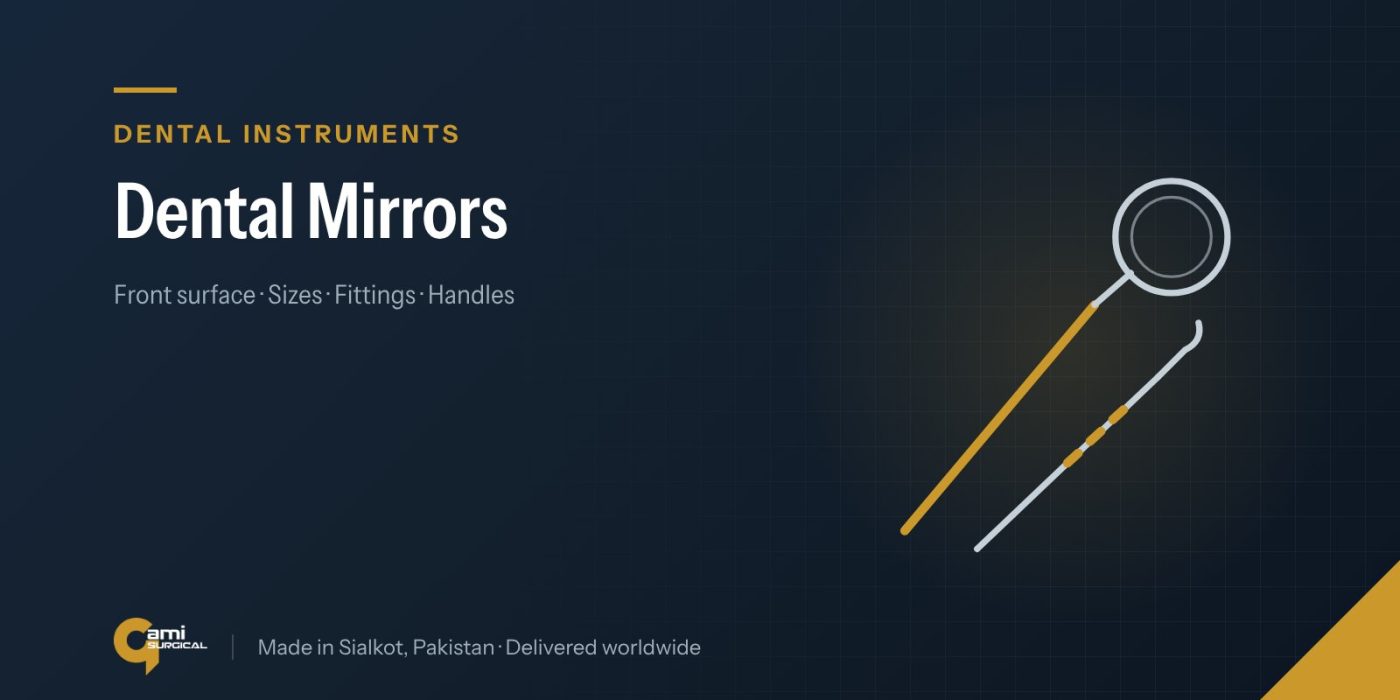
Dental mirrors are used in nearly every dental appointment, for indirect vision, retraction and reflecting light onto the teeth. Mirror heads wear out and scratch with use, so clinics replace them regularly. Knowing the options helps you order dental mirrors that suit your team.
In short
Front surface mirrors give a sharp, single image; standard mirrors are tougher. Choose the head size, match the fitting to your handles (cone socket or simple stem), and replace heads when they scratch.
Front surface or plane mirrors#
| Type | Image | Durability |
|---|---|---|
| Front surface | Sharp, no double image | Reflective layer on top; scratches more easily |
| Plane (rear surface) | Slight double image | Reflective layer protected under glass; more durable |
| Magnifying (concave) | Enlarged image | Useful for detail, slight distortion |
| Double-sided | Mirror on both faces | Lets the mirror retract and reflect at the same time |
Front surface mirrors with a rhodium coating are popular because they give a bright, clear image and resist tarnishing.
Head sizes#
Mirror heads are numbered by diameter. Common sizes are No. 4 (about 22 mm) and No. 5 (about 24 mm), with smaller sizes for children and tight areas. Many clinicians use a No. 4 or No. 5 for general examination.
Fittings: cone socket and simple stem#
Mirror heads screw into handles. Two thread systems are common: cone socket and simple stem. They are not interchangeable, so check which fitting your handles use before ordering heads. One-piece mirrors with fixed heads are also available.
Handles#
Mirror handles come in solid or hollow steel, with different diameters and grip textures. Hollow handles are lighter; wider handles reduce hand fatigue. Coloured rings help identify instruments in cassettes.
Care checklist
- Avoid abrasive cleaners and scouring, which scratch the surface.
- Protect mirror faces in cassettes so they do not touch other instruments.
- Dry mirrors fully after sterilization to avoid spotting.
- Replace heads that are scratched, cloudy or chipped.
Frequently asked questions#
Why does my dental mirror show a double image?#
Plane (rear surface) mirrors reflect from behind the glass, which can create a faint second image. Front surface mirrors avoid this.
Are mirror heads universal?#
No. Cone socket and simple stem threads differ, so match the heads to your handles.
How often should mirror heads be replaced?#
Whenever they are scratched or cloudy. Busy clinics often replace them several times a year.
Order dental mirrors from Gami Surgical#
Gami Surgical manufactures dental mirror handles and supplies mirror heads, with delivery worldwide from Sialkot, Pakistan. Send us the sizes, fittings and quantities you need for a quote.